Tuesday, 16 August 2011

In the summertime

Summer can be a relatively quiet time for birding and indeed July was fairly unproductive for us, but things have picked up with the arrival of August...
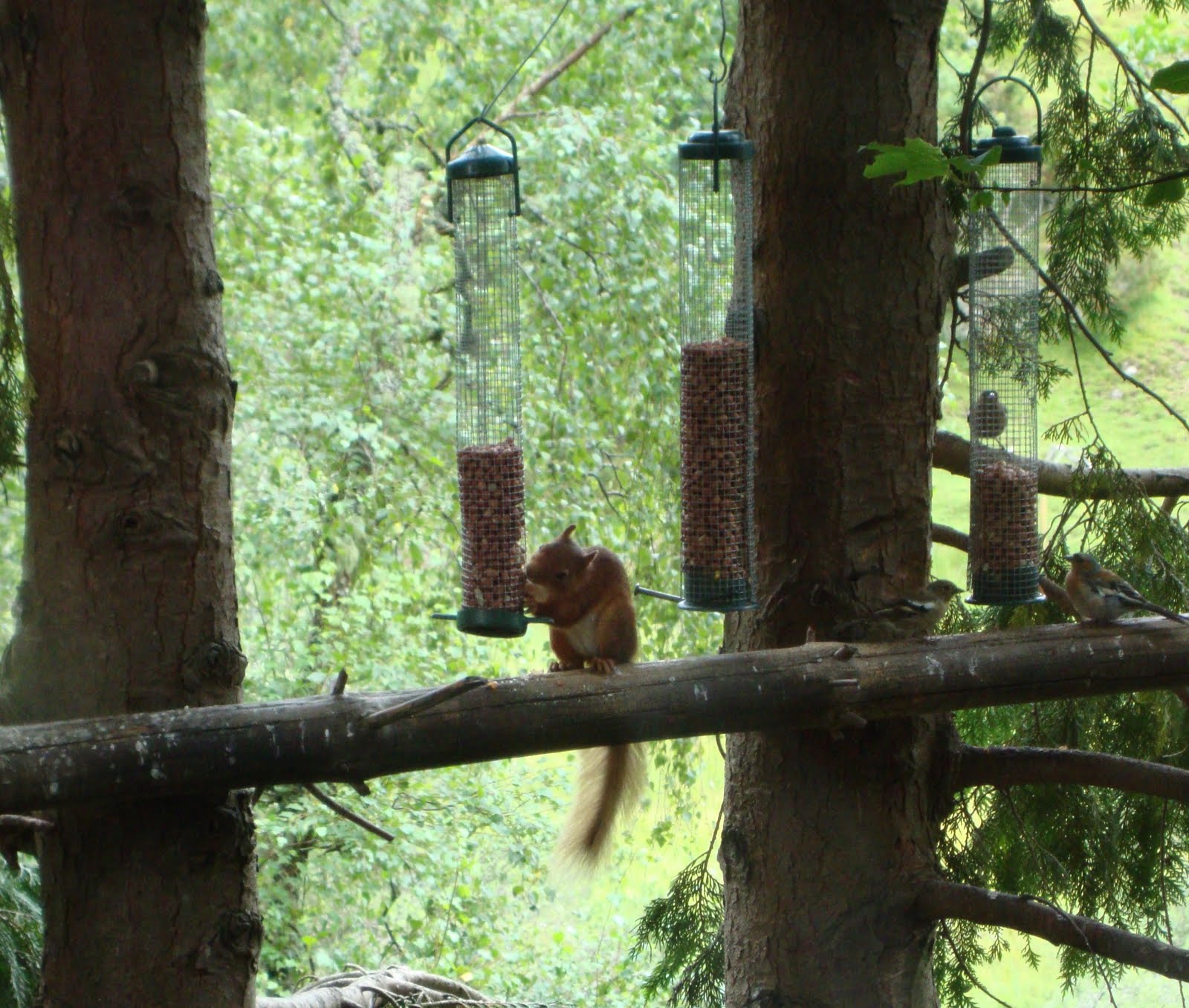
I spent the first week of the month in the Scottish highlands with Carolyn, Malcolm and Kate, watching Ospreys, summer plumage Black-throated Divers and Slavonian Grebes on tranquil lochs; Dippers in boulder strewn rivers; and Bottlenose Dolphins leaping out of the sea at Spey Bay. Another highlight was a visit to ‘The Potting Shed’ – without doubt one of the best tea rooms in Britain. Where else can you sit eating the most delicious cake while watching Coal, Blue and Great Tits, Siskins, Chaffinches and Red Squirrels on feeders a metre or two in front of you?
A day after returning from Scotland we were in Lincolnshire for our annual boat trip out of Boston into the Wash aboard the Boston Belle; followed by an afternoon visit to Frampton Marsh where these two young Sand Martins were being enticed out of their nest burrow by the parent birds [click on the photo to zoom in– they are cute].


This may have been one of the last times they were in the nest because very soon after the photo was taken I watched them launch themselves into the big wide world.
And coming more or less up to date, last weekend we visited Suffolk. RSPB Minsmere was fairly quiet, although we were pleased to see a party of five Lesser Whitethroats flitting through some Hawthorns not far from the visitor centre. And this Cape Shelduck was an interesting escapee...

After lunch we went to Sizewell beach with the aim of finding some Little Gulls which had been reported there. They were soon spotted just out to sea, flying around one of the rigs. While there we couldn’t resist a quick look to see if the Sizewell B Black Redstarts were still in residence – and fortunately they were.  I always find it slightly baffling that these birds choose stark industrial sites to raise their young – but they do. Here’s one of the young birds, completely at ease in its playground of barbed wire and stone walls.


Friday, 17 June 2011

The Farnes

Last weekend’s focus [9-12 June] was definitely on seabirds when I went with the Bedford RSPB Group on a four-day trip to Northumberland. The main purpose of the trip was to visit the Farne Islands, and that’s exactly what we did on our first full day there [Friday] - going to Staple Island in the morning, with seabird colonies covering the cliffs...

... and seabirds nesting just about wherever you looked.


Kittiwake


Guillemots
 
Eider Duck (female)
The afternoon was taken up with a visit to Inner Farne, where we had a close encounter with Arctic Terns...

Many of these Terns nest within inches of the footpath and then resort to dive-bombing and screaming at you as you make your way along it.


We also did a couple of early morning sea watches on Holy Island (aka Lindisfarne) where, apart from the birds, I was interested to see these upturned boats converted into sheds...

On Sunday morning, before starting the journey home, we were booked on the RSPB boat trip to Coquet Island, out of Amble, an island that holds the largest colony in Britain of endangered Roseate Terns – although even here they number only around 90 pairs. It was a treat to see them, but for me the birds of the trip, fortunately found on all the islands, were the wonderful little Puffins...


Wednesday, 1 June 2011

Cuckoo and Phalaropes

If Sunday had gone according to plan the title of this post could very well have been ‘Orioles and Bluethroat’, since those were the birds we were hoping to see when we visited RSPB Lakenheath and WWT Welney that day [29 May]. However, things didn’t quite work out as planned and we didn’t see either of those two species - but still had a great day.
At Lakenheath in the morning a smart male Garganey, Bitterns flying over the reed beds, three Hobbies perched together in a tree, and several Cuckoos calling and flying around more than made up for the elusive Golden Orioles which we could hear but not see. Cuckoos too can be difficult to see and so we were pleased when one settled in a tree at the edge of one of the poplar plantations...

... allowing us to watch it for a while - being blown about in the wind...


It was off to Welney for the afternoon, and as we waited [in vain] for a glimpse of the Bluethroat which is holding a territory there again this year, a birder near to us heard that a Red-necked Phalarope was on the water outside the Lyle hide, just along the path from where we were standing. There was in fact a pair - beautiful birds, both in summer plumage. I’d hadn’t really appreciated how small and delicate these birds are, but it was strikingly apparent whenever they were close to the Mallards and Avocets sharing the water with them. Apart from avoiding occasional harassment from one of the Avocets, both birds fed just about non-stop...

Red-necked Phalaropes are one of the bird species where the roles of the sexes are reversed when it comes to breeding. The larger, more brightly coloured females pursue males and compete for territory and once they’ve laid their eggs, leave the males to incubate them and raise the young. Here they are again for comparison. Based on the above the female must be the bird closest to the camera [they were quite distant so click on the photo for a better look].

Thursday, 19 May 2011

Born in the USA

May is often a good month for finding vagrant birds in the UK and it seems recent weather systems have blown a few across the Atlantic because within the last week I’ve been lucky enough to catch up with two American waders. On Sunday at Cley Marshes, Norfolk, we saw a Lesser Yellowlegs – feeding in pools close to the west bank, along with some Wood Sandpipers and Temminck’s Stints. Even better though, to my mind, was a Spotted Sandpiper that turned up at Caldecotte Lake in Milton Keynes last Thursday [12 May], just a few minutes’ drive from where I work. The Sandpiper was easy to find - sitting at the end of the pontoon from where it had been reported earlier - and I stood watching it, with two or three other birders, from the path leading to the pontoon. We were careful to keep a reasonable distance in case we spooked it; but we needn’t have worried because after a few minutes, incredibly, it got up and walked towards us until it was just few metres away. It doesn’t get much better than that – close up views of an exceptional bird.
I hadn’t expected to go birding that day and so didn’t have my camera with me [wouldn’t you know it!] but Carolyn and Malcolm went to see it later and have kindly let me use one of their photos...
Spotted Sandpiper

Saturday, 14 May 2011

Return to Lagoon Cottage

It felt a bit like going home. I walked into that cool bedroom with its tiled floor, wooden shutters and wedgewood blue iron bedstead, and it was almost as if I hadn’t left. I was back at Quinta Cerro da Vela [Lagoon Cottage] in Arroteia, southern Portugal for two weeks [20 April - 4 May], and looking forward to seeing some good birds.
My previous visit had been an autumn one [October 2010] so early mornings up on the roof this time were spent watching and listening to a whole new suite of birds in and around the garden – Serins, Bee Eaters, Corn Buntings, Golden Orioles, and Cuckoo.
We packed a lot into every day; up early and off to our favourite birding spots - salt pans, lagoons, woodlands, wetland reserves, tree-covered hills and river gorges, and the plains of the Alentejo region. Arguably some of the best days were those when we crossed the border to Donana National Park, in Andalucia, with the highlight being the fabulous Jose Valverde Centre. Standing in the Visitors Centre you look out over a lagoon that holds a teeming heronry with...
Glossy Ibis


Cattle Egret

Purple Heron

Squacco Heron

Night Heron

and Great Reed Warblers singing from every patch of reeds...

Among the birds seen on drives along the tracks were stunning Montagu's Harriers, a party of Lesser Kestrels, Black and Whiskered Terns skimming over flooded grassland, Collared Pratincoles, a pair of Marbled Teal, and a Temminck's Stint...


But no matter where we went, every day was unforgettable. On visits to the Alentejo we saw displaying Great Bustards – almost turning themselves inside out to impress the females, Little Bustards, White-rumped Swifts, Black-bellied Sandgrouse, Roller...


Black-eared Wheatear...

and - possibly the bird of the trip - a Short-toed Eagle circling just above us, eating a snake that it held in its talons.
We called in at Odiel Marsh in Spain for this Coot with curlers...
Red-knobbed Coot


In reed beds around the lake at Quinto da Lago golf course lived this little gem of a bird...


Black-headed Weaver

– actually an African species but established in Portugal from escaped captive birds.

One bird found just about everywhere was the Corn Bunting, nearly always belting out its jangling song - but not this one, which was presumably collecting food for its young...

And not just birds. This Tortoise was making its way across the track at Vilamoura. I’m not sure that there are any native tortoises in Portugal so it may have been an abandoned/ escaped pet – I’ll have to look it up. But whatever, it was interesting to see. We decided to put it back into vegetation by the side of the track as it was in danger of being run over, but Paul wasn’t sure the tortoise would be too pleased about that. He reckoned it had probably taken it a couple of weeks to get that far.

This snake, however, was definitely a wild one.

I think it’s a Viperine snake - a relatively common European water snake (but again - more research is needed). That would certainly fit with where we found it - slithering down a concrete water course near a water treatment plant.
Even at the end of each day the birding didn’t stop. Most evenings, after eating at a local restaurant, we’d stop along the narrow roads home to try to pick out from amongst the chorus of cicadas and frogs, the strange calls of Red-necked Nightjar.  One evening we were lucky enough to see one on the road in front of the car. And during the night we had our own garden Little Owls. They’re noisy little devils and often disturbed my sleep, but I didn’t mind – in fact I loved lying in the dark listening to their screeching calls and eerie little song. So to close, here’s one of them in daylight - using the cottage gate post as a sheltered resting place...