Thursday, 19 May 2011

Born in the USA

May is often a good month for finding vagrant birds in the UK and it seems recent weather systems have blown a few across the Atlantic because within the last week I’ve been lucky enough to catch up with two American waders. On Sunday at Cley Marshes, Norfolk, we saw a Lesser Yellowlegs – feeding in pools close to the west bank, along with some Wood Sandpipers and Temminck’s Stints. Even better though, to my mind, was a Spotted Sandpiper that turned up at Caldecotte Lake in Milton Keynes last Thursday [12 May], just a few minutes’ drive from where I work. The Sandpiper was easy to find - sitting at the end of the pontoon from where it had been reported earlier - and I stood watching it, with two or three other birders, from the path leading to the pontoon. We were careful to keep a reasonable distance in case we spooked it; but we needn’t have worried because after a few minutes, incredibly, it got up and walked towards us until it was just few metres away. It doesn’t get much better than that – close up views of an exceptional bird.
I hadn’t expected to go birding that day and so didn’t have my camera with me [wouldn’t you know it!] but Carolyn and Malcolm went to see it later and have kindly let me use one of their photos...
Spotted Sandpiper

Saturday, 14 May 2011

Return to Lagoon Cottage

It felt a bit like going home. I walked into that cool bedroom with its tiled floor, wooden shutters and wedgewood blue iron bedstead, and it was almost as if I hadn’t left. I was back at Quinta Cerro da Vela [Lagoon Cottage] in Arroteia, southern Portugal for two weeks [20 April - 4 May], and looking forward to seeing some good birds.
My previous visit had been an autumn one [October 2010] so early mornings up on the roof this time were spent watching and listening to a whole new suite of birds in and around the garden – Serins, Bee Eaters, Corn Buntings, Golden Orioles, and Cuckoo.
We packed a lot into every day; up early and off to our favourite birding spots - salt pans, lagoons, woodlands, wetland reserves, tree-covered hills and river gorges, and the plains of the Alentejo region. Arguably some of the best days were those when we crossed the border to Donana National Park, in Andalucia, with the highlight being the fabulous Jose Valverde Centre. Standing in the Visitors Centre you look out over a lagoon that holds a teeming heronry with...
Glossy Ibis


Cattle Egret

Purple Heron

Squacco Heron

Night Heron

and Great Reed Warblers singing from every patch of reeds...

Among the birds seen on drives along the tracks were stunning Montagu's Harriers, a party of Lesser Kestrels, Black and Whiskered Terns skimming over flooded grassland, Collared Pratincoles, a pair of Marbled Teal, and a Temminck's Stint...


But no matter where we went, every day was unforgettable. On visits to the Alentejo we saw displaying Great Bustards – almost turning themselves inside out to impress the females, Little Bustards, White-rumped Swifts, Black-bellied Sandgrouse, Roller...


Black-eared Wheatear...

and - possibly the bird of the trip - a Short-toed Eagle circling just above us, eating a snake that it held in its talons.
We called in at Odiel Marsh in Spain for this Coot with curlers...
Red-knobbed Coot


In reed beds around the lake at Quinto da Lago golf course lived this little gem of a bird...


Black-headed Weaver

– actually an African species but established in Portugal from escaped captive birds.

One bird found just about everywhere was the Corn Bunting, nearly always belting out its jangling song - but not this one, which was presumably collecting food for its young...

And not just birds. This Tortoise was making its way across the track at Vilamoura. I’m not sure that there are any native tortoises in Portugal so it may have been an abandoned/ escaped pet – I’ll have to look it up. But whatever, it was interesting to see. We decided to put it back into vegetation by the side of the track as it was in danger of being run over, but Paul wasn’t sure the tortoise would be too pleased about that. He reckoned it had probably taken it a couple of weeks to get that far.

This snake, however, was definitely a wild one.

I think it’s a Viperine snake - a relatively common European water snake (but again - more research is needed). That would certainly fit with where we found it - slithering down a concrete water course near a water treatment plant.
Even at the end of each day the birding didn’t stop. Most evenings, after eating at a local restaurant, we’d stop along the narrow roads home to try to pick out from amongst the chorus of cicadas and frogs, the strange calls of Red-necked Nightjar.  One evening we were lucky enough to see one on the road in front of the car. And during the night we had our own garden Little Owls. They’re noisy little devils and often disturbed my sleep, but I didn’t mind – in fact I loved lying in the dark listening to their screeching calls and eerie little song. So to close, here’s one of them in daylight - using the cottage gate post as a sheltered resting place...

Thursday, 7 April 2011

Reasons to be cheerful

There were plenty of reasons to be cheerful when we visited Breckland sites on Sunday. For us it was displaying Wood Lark and Goshawk at Olley’s Farm, a Great Grey Shrike at Grimes Graves, and four Stone Curlews at Weeting Heath - the most we've ever seen at this site.

But more importantly, for the birds it was just that Spring had arrived - singing and displaying on a warm, sunny day. We loved seeing them all, not just the rarer birds. In fact, this Yellowhammer was one of our favourites, here perched at the top of a pine tree…


… and this little Wren – singing his heart out from a convenient stump in the middle of a pine planting.


Wednesday, 30 March 2011

The Fellowship of the [Birding] Ring

Last weekend’s birding trip - a long weekend in mid Wales with friends from the Bedford RSPB Local Group - included a couple of what I can only describe as ‘Tolkien’ moments.  On Friday afternoon as we sat in the hide at Gigrin Farm, Powys waiting for the Red Kite feeding session to begin there was almost an air of menace as birds started to gather in trees around the feeding area, anticipating the gory banquet they were soon to take part in.

Red Kite

The Ravens in particular wouldn’t have looked out of place in any supernatural tale – dark forms against a background of knarled, misshapen branches…


As soon as the meat had been spread over the ground a free-for-all ensued that was mesmerizing to watch. By this time the sky was full of Kites; they preferred to use their aerial skills to get the food – swooping down one after the other and grabbing chunks to fly away with. By contrast the Buzzards and Corvids landed on the grass to eat…


… or stuffed as much as they could in their beaks before flying off somewhere to feast undisturbed.


The drama was non-stop and there was so much going on you hardly knew where to look for fear of missing something good – an unforgettable afternoon and definitely a wildlife spectacle not to be missed.

On Saturday a walk round RSPB Ynys-hir reserve and a cliff walk at Clarach Bay made a very pleasant day, but on Sunday morning we were back in Lord of the Rings terrain - RSPB Gwenffrwd-Dinas reserve. The path round this reserve crosses the steep slopes of a deep river valley. It was narrow and winding and as we made our way up and down through the boulders I was reminded of Frodo and his companions trying to cross the Misty Mountains – a band of intrepid heroes with tall, bearded Gandalf leading the way [oh yes, we even had our own Gandalf].

Even though it was hard going at times and quite treacherous in places it has to be said that no-one complained (although at one point I did hear a faint, anguished cry of ‘Is there a pub up here’).

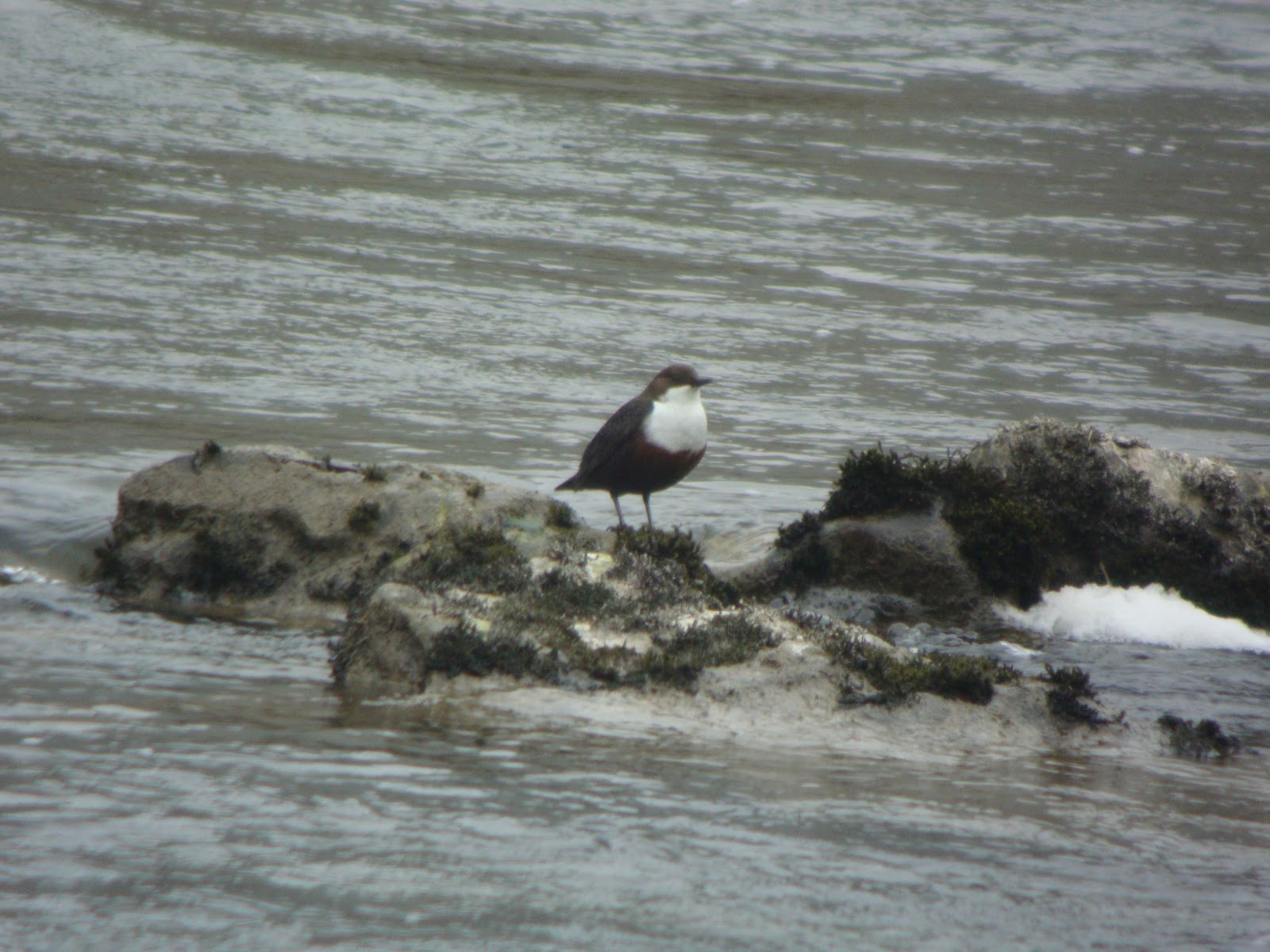
Thinking that the others might be cheered by my comparison of our situation to that of the brave Middle-earth characters, I mentioned it to Paul who was next to me. His response - an indignant ‘Are you suggesting I’ve got short legs and hairy feet?’ - was not the reaction I’d hoped for. Hastily changing the subject, I decided to concentrate instead on watching out for any marauding Orcs – but thankfully they must have decided to take the day off, as none were seen. We did, however, get enchanting views of this little water sprite...

Dipper

After lunch we set off on the journey back home to The [Bedford] Shire, happy with the weekend’s birding and looking forward to our summer adventure in the wilderness of Northumberland. Who knows what wondrous creatures we’ll find there…

Monday, 14 March 2011

Homeward bound

Last weekend was mostly about seeing birds that were on route back to breeding grounds - whether breeding grounds in the UK or other countries.

At Dungeness on Saturday there were still several Smew viewable from the Hanson ARC hide, but it was surely one of the last opportunities I’ll have of seeing a redhead female Smew... 


or a ‘white nun’ male…


… before they head off to northern European forests for the summer.

The plan for Saturday had originally been Elmley Marshes and Rainham, but Malcolm made a last minute decision [we’re talking half an hour before we left!] to switch to Dungeness, thinking that it would give us a chance of seeing some early arriving spring migrants, and possibly the Penduline Tits reported there earlier in the week. As it turned out, the Pendulines didn’t show, but that aside - good choice Malcolm!

Our first ‘incomer’ was a Firecrest in scrub near the Christmas Dell hide. We had the most incredible views of this normally skulking tiny bird because its behaviour was more like that of a flycatcher – repeatedly launching itself into the air to take an insect and then landing on a branch or bush for a few seconds (which, luckily, were still leafless) before flitting into lower vegetation, obviously to ready itself for its next appearance.

And later in the afternoon, while on the beach near the power station for some sea watching we learned that two more early migrants were in the vicinity. It took us a while to find them but we eventually did, and what a welcome sight it was to see the first Wheatear of the year, and a Black Redstart bobbing up and down in the garden of the house next door to the lighthouse …


The next day, a morning walk around RSPB the Lodge, Sandy [with Beds Birders], and particularly time spent in the hide, gave close up views of Siskins…


and Lesser Redpolls...


… and best of all, a couple of Mealy Redpolls (unfortunately, didn’t get any photos of those). I hadn’t seen this larger, northern species of Redpoll before, or at least not such that I could be certain of the identification, but when you have the Beds bird recorder pointing them out - that’s a tick.

On the way back from Sandy we finished our birding weekend with some birds undoubtedly leaving Britain soon for their Scandinavian home lands - 100+ Waxwings at G&M Growers in Upper Caldecotte. The sound of their trilling calls filled the air and several times large groups flew over our heads to berry-laden bushes of the other side of the car park – where they ravenously gobbled down as many berries as they could before flying back to taller trees. Stocking up for the journey ahead I guess.